
Thai wedding traditions in order, from the groom's side: what each step asks of you, who leads you, and the two things to agree with her family first. With our count of 266 Thai commenters.
 CultureThai Girlfriend Giving You the Silent Treatment? What to Do23 min read
 CultureWhat Is a Ladyboy? Meaning, Surgery and Thai Culture29 min read
 CultureThai Women Dating Culture: Etiquette for Foreigners26 min read
 CultureThai Culture Dos and Don’ts: The Reason Behind the Rules22 min read
 Relationship SkillsRelationship Skills for Couples, With a Thai Woman24 min read
Contents · 14 sections
A traditional Thai wedding ceremony often fits into one day: a morning blessing by monks, the groom’s procession, “gates” he pays to pass, the engagement, a water blessing, wrist-tying and a party. Each family chooses which steps it holds, and an elder leads you through them. Agree first how many gates, and what goes in each envelope.
The guides we read explain what each ritual means. This one stands where the groom stands, a foreign man marrying a Thai woman, and says what each step asks of you, who leads you through it, and what to settle with her family before the day. We also counted what 161 Thai commenters on one public forum said about a groom who walked out at the fifth of 13 gates, and what 105 said about cutting a wedding down, because the money and the size of the day are the two things your side has to settle. Keep in mind from the start that the ceremony is a family event, and it is not the legal marriage: that is a separate registration with a registrar, usually at a district office. If you are going as a guest, the last main section, on what to wear and how much to give, is the one for you.
Thai wedding ceremony traditions in order: what the groom does at each step
The day runs in roughly this order, and each step asks little of you once someone has told you what it is. This is one common form of a Buddhist Thai wedding, not a fixed programme: families shorten, drop or reorder steps, and customs differ from region to region, so ask her which ones her family plans.
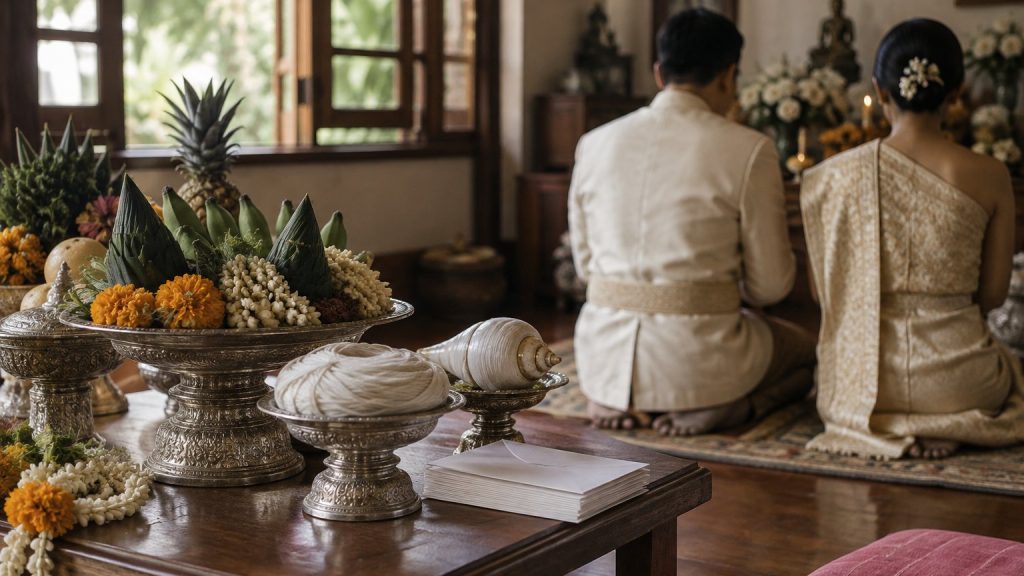
- Morning merit-making with monks. You and the bride offer food to an odd number of monks, usually three, five, seven or nine, then sit lower than them, hands together, while they chant.
- The khan maak procession. Your side walks to her family’s house with trays of gifts, often with drums and dancing, and you walk behind the elder who leads you.
- The gates. Her relatives block the path with chains or sashes, the “silver gate” and the “gold gate”, and your side hands over an envelope of money to pass each one.
- The engagement. The elder speaking for you asks for the bride, the sin sod (the money your side gives her parents) and the engagement gold are shown, and you put the ring on her finger.
- Sai monkhon and rod nam sang. An elder places twin loops of white thread on your heads, and guests pour water from a conch shell over your joined hands, one by one.
- Wrist-tying. Elders tie white strings round your wrists with a blessing.
- The party. Usually in the evening, with food, speeches and photos, where you greet guests and thank her family.
Most of the ritual sits in the morning. The Knot’s guide says it is common for every element of a modern Thai wedding to happen on the same day 1. Thaizer puts the monks at three, five, seven or nine, notes that some couples move the engagement onto the wedding day to save money, and says a wedding in the south can be very different from one in the north 2.