
If you're talking to a woman from the Philippines online and something feels off, a Filipina scammer list seems like a quick way to check her. Lists like that do exist, mostly as Facebook groups and websites. Here's what they can and can't tell you, and three checks that work better, whatever her name is.
 Online SafetyRed Flags When Dating a Filipina25 min read
 Filipina RelationshipsMarrying a Filipina: Requirements and What to Expect25 min read
 Filipina RelationshipsFilipina Girlfriend Allowance and Family Money22 min read
 Filipina RelationshipsHow to Court a Filipina Long Distance: What Changes20 min read
 Filipina RelationshipsHow to Find a Filipina Wife: The Question Behind It24 min read
Contents · 11 sections
The short answer: a list can warn you, but it can’t tell you she’s safe. A list only holds names and photos someone reported before. The scam operations police keep raiding in the Philippines work from scripts and fake photos, and a character can carry on under a new name the day the old one gets reported. Some scammers now create brand-new photos with AI. So look her up if you like, but don’t stop there. Before any money moves or you book a flight, check three things: that she’ll get on a live video call and respond to what you say, that her story stays the same over weeks, and where any money would actually end up.
Filipina scammer lists and scammer photos: what a match or a miss tells you
Search for a Filipina scammer list and you’ll mostly find Facebook groups and websites where men post the names and photos of women they say scammed them. We don’t link to them or repeat them, because none of them shows how, or whether, anyone checks what gets posted. If you do look one up, here’s how to read what you find.
If you find her photo, it tells you the picture has been used before, in someone else’s report. It doesn’t tell you who is typing to you, and it doesn’t make the woman in the picture a scammer: her photos may have been taken from her own account without her permission. Treat a match as a reason to stop sending money and ask questions, not as proof of who she is.
If you find her name, that tells you even less. Plenty of women share a name, and a scammer can change one in seconds.
If you don’t find her, you’ve only learned that this name and these photos aren’t on that list. In September 2026 the NBI described a love-scam operation in Makati that worked from scripts and fake photos of women.1 When one of their characters gets reported, the script can carry on under another name and another face, and a list built on the old ones won’t catch it.
A scammer list can only ever warn you. Finding her on one is a reason to stop and ask questions; not finding her tells you almost nothing.
And don’t add anyone to a list yourself, or post a woman’s face with the word “scammer” under it. Besides the risk of accusing the wrong woman, libel committed through a computer is a crime in the Philippines under the Cybercrime Prevention Act.2 Report the profile to the platform and the police instead. If you want to know whether a post you have in mind would cross that line, a lawyer in the Philippines is the person to ask.
Quick poll
Have you looked a match up on a scammer list or group?
Anonymous count, nothing else stored.
Reverse image search: how to find out if a photo is from a scammer
A reverse image search lets you upload a photo and see where else it appears online. Most search engines have one built in, and it takes a minute: take a screenshot of her photo, crop away the app’s buttons and frame, upload it to the image search, then open the pages where it appears rather than trusting the thumbnails. Never upload an intimate image. It’s worth doing, as long as you know what the result means.
If her photo turns up under another name, on a model’s page or on someone else’s account, the profile is probably using pictures that aren’t hers. Pause any money and ask her about it on a video call. If it’s clear the profile uses someone else’s pictures, report it to the platform. Don’t contact or post the woman in the photos: she may well be a victim too, and a picture alone can’t show she’s involved.
If her photos turn up on other accounts in her own name, that feels like proof she’s real, but it proves less than it seems. Anyone who can create photos of one invented woman can also open a few social media accounts for her, with the same face at the beach, at work and at a family party, and a search will then find exactly what it would find for a real person.
If nothing turns up, don’t read that as good news. The search only finds copies of pictures that are already online. That catches the old trick of building a profile from a stranger’s photos, but it can’t catch photos that were never online before. The FBI warned in December 2024 that criminals now use AI to create realistic photos for fake profiles in romance and investment scams.3 A set of AI photos of one invented woman, in different places and outfits, has nothing to match. The search also misses real photos that were never posted publicly. So a search can catch a careless scammer, but it can’t show that anyone is real. For that, you need the video call and the money check below.
We tested this in October 2026. With an AI image tool, we made one woman who doesn’t exist: four ordinary phone-style photos of the same face, at a cafe, at work, at a family birthday and by the sea, in about two and a half minutes. Then we ran each photo through four reverse image searches: Google, TinEye, Bing and Yandex. None of them found her photos anywhere, because they exist nowhere. The same searches found a real public figure’s photo straight away, on news sites and on pages that had reused it.
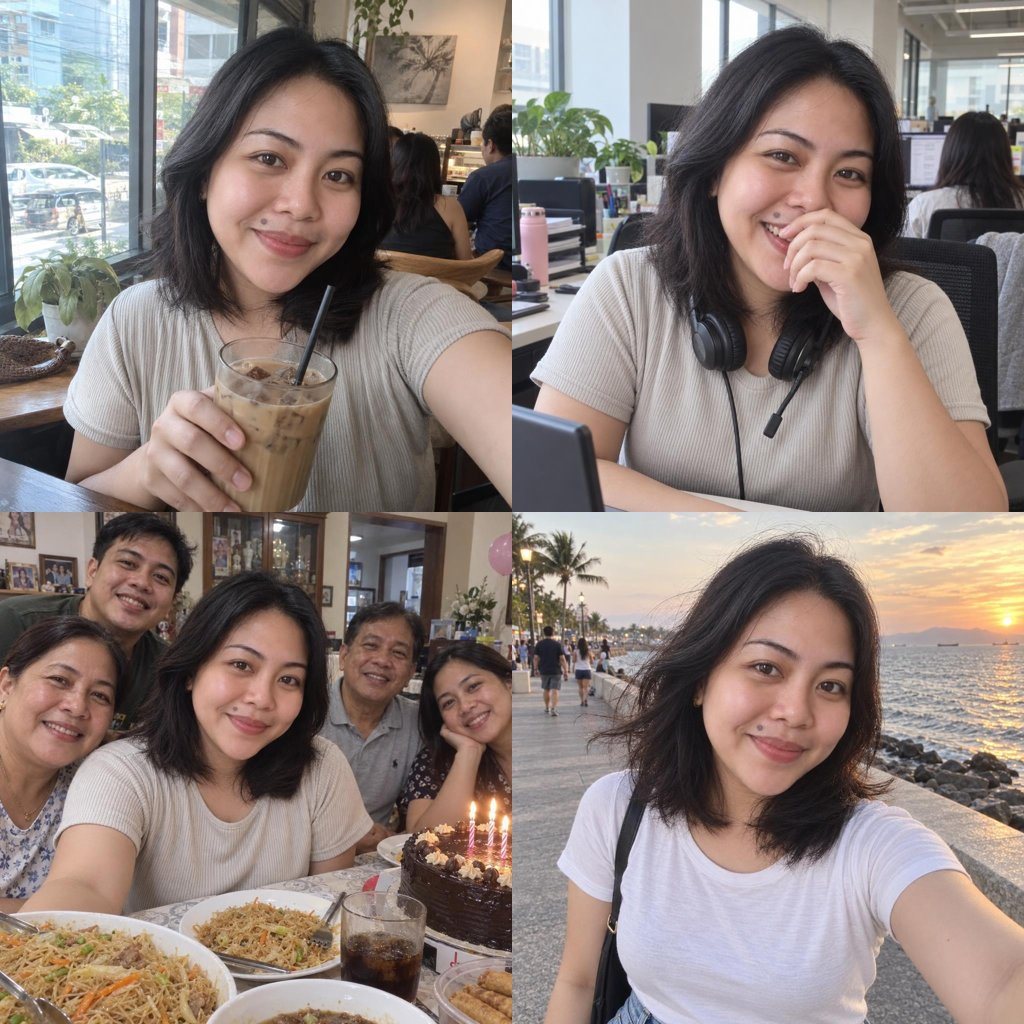
What the searches showed instead is the bigger trap. Cropped to her face, our photos brought up dozens of “visual matches” on Google: real women who look a little like her, on profile pages, babysitting sites and social accounts. For one photo, Google listed a single “exact match”: a real woman’s professional profile picture. Our editors compared the two. They look alike, but they are not the same person, and she has nothing to do with our test. Bing and Yandex offered look-alikes too, and on the uncropped photos every search fixed on the iced coffee rather than her face.
So a search can mislead you both ways. Finding nothing doesn’t mean she’s real, and a “match” may be a stranger who happens to look like her. Only the same photo, under another name, tells you something. Never contact or accuse the person a search turns up.
A reverse image search only catches a careless scammer. No match proves nothing, and a “match” can be a stranger who looks like her: in our test, Google called a real woman’s photo an exact match for a face that doesn’t exist.
A Facebook profile with no history tells you about as much. A new account, a handful of friends and no photos that other people tagged her in are reasons to run the checks, not a verdict.
Filipina romance scams: real cases from police and immigration records
If you searched for Filipina scammer stories, these are the real ones, from police and immigration records rather than forum posts. Looking across them, from 2014 to 2026, three things stand out, and each one changes what you should watch for.
The money ask has changed. In 2014 the trap was a recorded video call and a threat. By 2025 the script Australian police recovered ended with a friendly offer to teach you a small crypto investment, and the Manila hub raided that October sent its targets links to fake crypto platforms. If you’re only watching for a request for help, you’ll miss the newer version, and the old one hasn’t gone away. Watch for anything that would send your money somewhere: an app, a link, an account.
A request for money can arrive dressed as an opportunity instead of an emergency. Either way, the question is the same: who decides where your money goes?
These are businesses with scripts. Raids in Bamban, Pasay, Malate and Makati found organised operations, from dozens of people to hundreds, working from written scripts. A woman can be real, on camera and still be reading someone else’s lines, so being real isn’t the same as being honest.
The person typing may not be free, and Filipinas get targeted too. Rescued workers in Bamban said they were punished for missing quotas and had their passports taken, and Philippine officials warn Filipinas about scams aimed at them. That’s why every check on this page is about the conversation, never about where a woman is from.
Here are the cases, oldest first. We name no suspects: this page is about how the scams work, not about accusing anyone.
- May 2014, sextortion. Philippine police, working with INTERPOL, arrested 58 people in sextortion networks with victims in the UK, the US and elsewhere.4 A “woman” contacted men on Facebook, recorded explicit video calls, then demanded money to keep them private.5 The lesson: keep calls with someone you haven’t met clothed, and know that meeting someone doesn’t make an intimate recording safe either.
- March 2024, Bamban, Tarlac. Police and the Presidential Anti-Organized Crime Commission rescued 871 people from a compound whose workers said it ran love, romance and crypto scams; workers who missed quotas were hurt, kept awake or locked up, and their passports were taken.6
- May 2024, scams aimed at Filipinas. The Bureau of Immigration warned Filipinas about fake immigration officers who say a foreign boyfriend is held at the airport over cash in his luggage and demand a fine; the bureau says it doesn’t deal with incoming currency or luggage at all.7
- October 2024, Pasay. Officers raided a hub whose main business was love scams and arrested more than 200 people, most of them Chinese nationals. News reports called it a POGO hub: a Philippine offshore gaming operator, an online gambling business aimed at players abroad.8
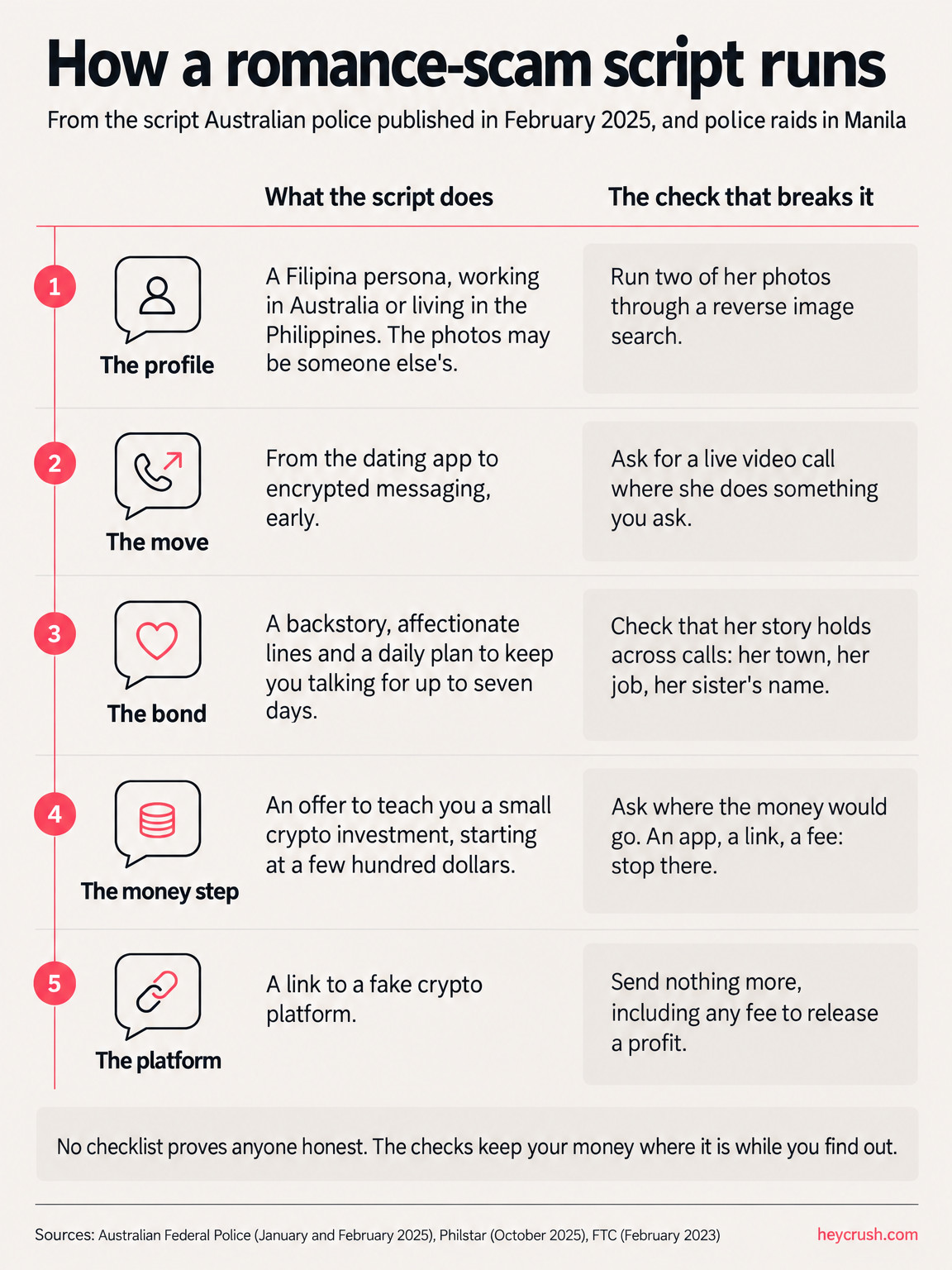
- January and February 2025, a script written for men like you. Australian Federal Police, with Philippine authorities, released what they found at a Manila scam centre: Filipina personas working in Australia or living in the Philippines, aimed mostly at men over 35 on dating apps, moved to encrypted messaging and talked into buying crypto from a few hundred dollars. More than 5,000 Australians got a text warning.9 In February the AFP published the script itself: a backstory, affectionate lines and a daily plan to keep a man talking for up to seven days, then an offer to teach him a small crypto investment.10
- October 2025, Malate, Manila. The police Anti-Cybercrime Group arrested 39 people in three condominium units. Police said the group used AI-assisted chat to start relationships on dating apps, then sent victims links to fake crypto platforms; most of the Filipino suspects were women aged 20 to 40.11
- September 2026, Makati. The NBI arrested 120 people, mostly Chinese nationals, in an operation that used scripts and fake photos of women; the NBI’s director said the victims were foreigners and Filipinos alike.1
She never asked for money: does that mean she’s real?
No. Months without a request tells you she hasn’t asked, not why. In the script Australian police recovered, the money step isn’t a plea for help: the character is heartbroken, kind, and running a small crypto sideline she offers to teach you.10 The Malate hub sent its targets links to a trading platform, not a hospital bill.
Not asking for money fits a genuine relationship too, but it doesn’t prove one, so the question to ask isn’t whether she asks. It’s whether a route for your money ever appears: an app she wants you to try, a link, a “sideline”, a ticket, a fee, an account belonging to a cousin. A request for help and an offer to make you rich end in the same place. Once that route appears, the answer is the same whoever she is: your money stays where you can see it.
The question isn’t whether she asks for money. It’s whether a route for your money ever appears: an app, a link, a fee, someone else’s account.
How to check a match yourself: a checklist before you send money or book a flight
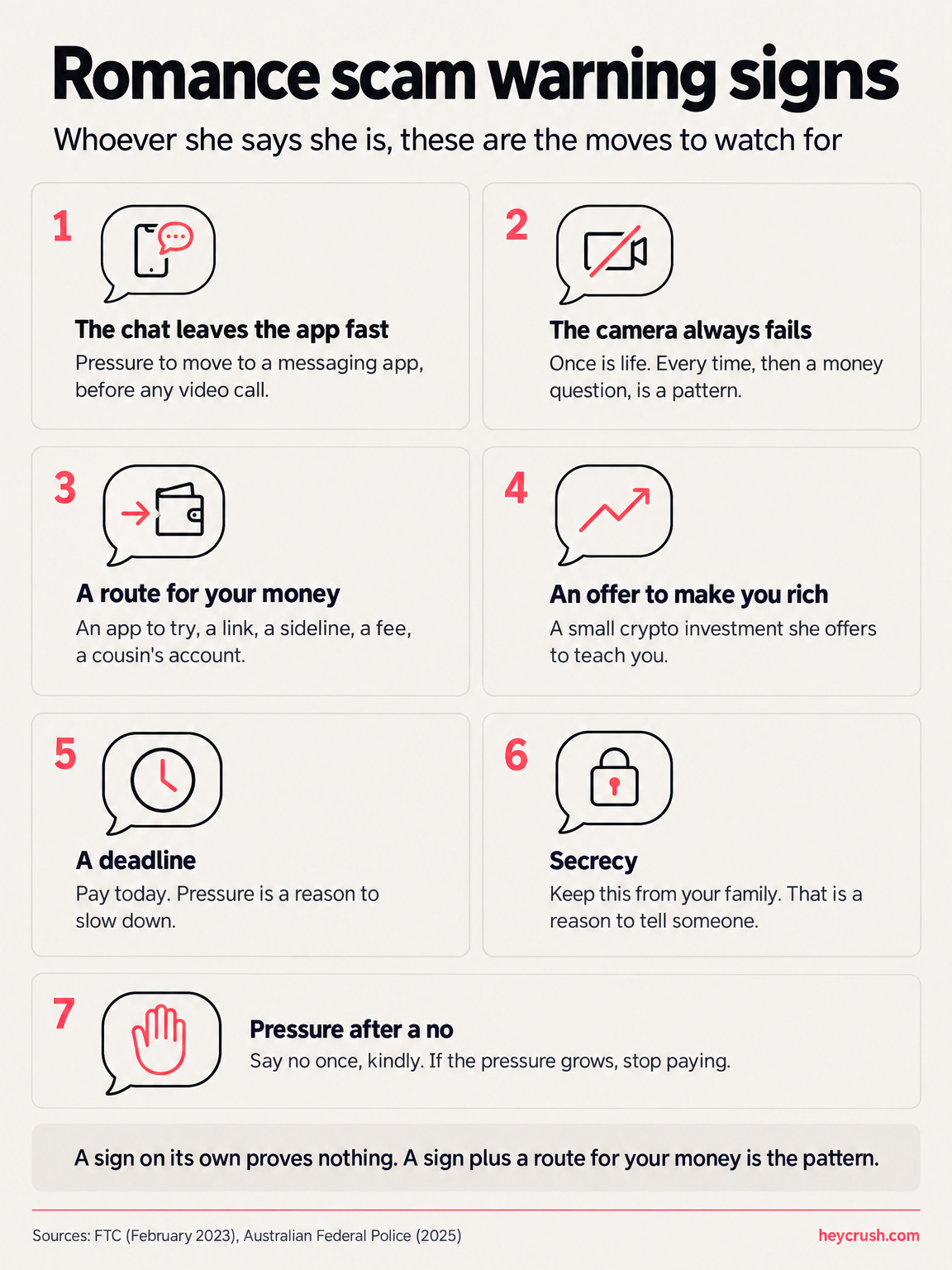
None of these checks accuses her of anything, and none of them needs to pry: keep calls short, and don’t ask for anything that would show where she lives. A refusal doesn’t prove fraud; it means you don’t yet know enough to send money. Run them before money moves:
- A live video call where she does something you ask. Wave, say your name, hold up three fingers. A recording can’t answer you. Keep it clothed.
- The same story across calls. Her town, her job, her sister’s name. Ask about something she mentioned weeks ago and see if it holds.
- Her photos, searched. Run two of them through a reverse image search: her photos under someone else’s name are a warning; a look-alike or no result is no answer either way.
- Where the money would go. An app, a trading platform, a link, a fee, a third person’s account: stop there, whatever the reason given.
- No deadline. Pressure to pay today is a reason to slow down. Even a real deadline doesn’t oblige you to send money you can’t check.
- No secrecy. Being asked to keep a payment from your family or hers is a reason to tell someone.
- Institutions, not people. If you help with anything, pay the hospital, the airline or the school directly. Find their contact details yourself, not from a document or link she sends, and confirm the bill and how to pay it. Even a genuine bill tells you nothing about the relationship.
- She can hear no. Say no once, kindly, and watch what follows. If the pressure grows after a no, stop paying, whoever she turns out to be.
Before you book a flight, add one more:
- Your own room and your own way home. Book and pay for your own accommodation, keep your passport and return ticket in your hands, and tell someone at home where you’re staying and when you land.
You don’t have to prove a scam before refusing a payment or postponing a flight. And no checklist proves anyone honest: a call can be passed by a real woman reading a script. What the checks do is keep your money where it is while you find out.
The checks only work one way. Failing one is a reason to pause; passing all of them never makes a request for money safe.
Challenge yourself
Can you spot the scam?
Six short chats. For each one, decide: scam, real, or can’t tell yet. Then see what gives it away, and how you did against everyone else.
1. Joy
- Good morning! Did you sleep well? I was thinking about you on my way to work.
- Morning! Busy day ahead. You?
- Same, my shift starts soon. On my break I check my trading app. My auntie taught me crypto and it’s been really good for us.
- If you want, I can show you how. You can start small, even $200. I just want us to have a future together 😊
Answer: scam
This is the move from the script Australian police published: a sweet, ordinary chat, then an offer to teach you a small investment. She isn’t asking for help. She’s opening a route for your money.
The check that settles it: Your money stays where you can see it: never use an app, platform or link chosen by someone you met online.
2. Lyn
- Sorry I disappeared, no power here again 😩 my phone is at 9%
- No worries! Call tonight?
- Yes! 8pm my time? My sister wants to say hi too, she keeps teasing me about you haha
Answer: real
Nothing here asks for anything. She offers a live call and brings her family into it, which is what real people do.
The check that settles it: Keep the call, and see whether she responds to you in real time.
3. Mae
- Babe I’m so scared, my mama is in the hospital and they won’t treat her until we pay the deposit
- I hate asking you. Can you send 15,000 pesos to my cousin’s GCash? The hospital takes it from there
- Which hospital? I can call them.
- Please there’s no time, they said today only 😭
Answer: scam
Mothers do get sick. But the money goes to someone else’s account, there’s a deadline, and she brushes off your offer to call the hospital. Philippine law also bars hospitals from demanding a deposit before emergency care.
The check that settles it: Offer to pay the hospital directly, using contact details you found yourself. If that route never works, don’t switch to a personal account.
4. Rica
- Hi! I love your smile in your third photo 😊 where was that taken?
- Ha, thanks! Lake Tahoe last summer.
- So nice! I’m not on this app much. Can we talk on WhatsApp instead? It’s easier for me
Answer: can’t tell yet
Moving to another app is normal for real people too, and nothing has been asked yet. Scripts open the same way, so these messages alone can’t tell you.
The check that settles it: Moving apps is fine. Ask for a live video call early, and watch whether a route for your money ever appears.
5. Grace
- Sorry love, my camera is broken again 😔
- That’s the third time. Can we at least do a voice call?
- The mic is broken too. If you send $150 I can buy a new phone, then we can finally video call every day ❤️
Answer: scam
A camera that fails every time, then a request to pay for the very thing that would let you check her. You’d be paying for the check.
The check that settles it: Don’t pay for a phone, data or a ticket so a call can happen.
6. Bea
- Let me send you something for your birthday. What’s your account?
- Aww no need! Just call me on my birthday, that’s enough 😊
- And when you visit, you’re buying the halo-halo
Answer: real
You offered money and she turned it down for a call. A script is built to get money moving, so this is a good sign, though no single chat proves everything.
The check that settles it: Keep the checks that cost an honest person nothing: live calls, and a story that holds.
Nobody spots every script from the messages alone, and you don’t have to. The checks on this page are what protect you: a live call where she responds to you, and money that never goes where you can’t see it.
These chats are made up, built from scam scripts police have published and from ordinary couples’ conversations. We keep your answers and score anonymously, with the date, and nothing else.
How to tell if you’re chatting with a scammer on a video call
A live video call is the best check you have, but know what it can and can’t show. It can catch a recording, or a story that doesn’t hold. It can’t confirm who she is or that she’s honest: the person on camera can be real and still be reading someone else’s script, and she may not be the woman in the profile photos. The FBI says criminals already use AI to fake video in live calls; the examples it gives are people posing as executives and officials.3 What matters is whether she responds to you: answers a question you didn’t plan, laughs at the right moment, does the small thing you ask, and does it on more than one call.
A live call can catch a fake, but it can’t confirm who she is. Passing call after call still never makes an investment offer or a money request safe.
A camera that fails once is life. A camera that fails every time, followed soon after by a money question, is a pattern. Don’t pay for a new phone or more data so the call can happen: you’d be paying for the very check you were trying to make.
Moving from the dating app to a messaging app is normal for real couples too. It matters when it comes with pressure, before any call: many people who lost money to romance scams said the scammer moved the chat to a messaging app quickly,12 and the scam centre Australian police described in 2025 moved men to encrypted messaging the same way.
Quick poll
She asks to move from the app to WhatsApp on day two. What do you do?
Anonymous count, nothing else stored.
If anyone threatens to send a video of you to your family or friends, don’t pay: nothing makes a paid blackmailer delete anything. Save the messages, block, and report it to the platform and the police.
Help with a hospital bill or money for her family: scam or real obligation?
It can be either, and you don’t have to decide which to answer well. Helping family at home is not in itself a sign of fraud, and she may feel it as utang na loob, a debt of gratitude to the people who raised or helped her.13 If she mentions sending part of her pay home, she’s telling you about her money, not asking for yours.
When the ask comes to you, look at its shape. A real hospital bill has a hospital, a patient’s name and a statement. Offer to pay the hospital directly, using contact details you found yourself, not the ones on the bill she sent. If that route doesn’t work, you can decline rather than switch to a personal account under pressure. Philippine law also bars hospitals, in emergency or serious cases, from demanding a deposit as a condition of basic emergency care,14 so “they won’t treat her until I pay today” is a story to check before it’s a reason to wire money. A bill after treatment is normal.
Before you’ve met, you can also just say no without calling her a liar. Her family’s need could be real without making you the person who must pay it.
Quick poll
Her family needs help with a bill. What would you do?
Anonymous count, nothing else stored.
Ticket or visa money to visit you: scam or real?
If you want to help her visit, book and pay for the ticket yourself, with the airline, in her name. Never send cash for a ticket. Booking it yourself keeps the ticket money from going anywhere else; it doesn’t prove the trip or the relationship is real. Before you buy, check what she needs to enter your country on your government’s official website, and choose a ticket you can change or refund: a visa appointment is not a visa.
If she’s applying for a visa, ask her to show you the appointment booking on screen, and pay nothing to an “agent” or “fixer” who needs your money to speed things up: that’s the warning sign, not the visa. For anything about her actual visa chances, a licensed immigration lawyer is the person to ask.
If she messages that she’s been stopped at the airport and needs money for a fee, treat it as a script aimed at you: don’t pay a fine through her account or a cousin’s.
My friends say Filipinas online are scammers
Your friends have the risk right and the people wrong. Scam operations use Filipina personas to reach men like you, and Filipinas get targeted too: the Bureau of Immigration warns them about fake officers demanding a fine to release a foreign boyfriend, and the NBI said its 2026 Makati case had victims among foreigners and Filipinos alike. The people arrested in these raids were working inside organised operations, and in Bamban some workers were held there against their will.
So a woman is not a suspect because of where she’s from. A conversation is suspect because of what it asks of you. Run the checks; let them do the judging.
Quick poll
Has anyone warned you off meeting someone online?
Anonymous count, nothing else stored.
I already sent money to a scammer: what to do now
Stop sending, including any “fee” to release a profit, unlock an account or get your money back. Then:
- Contact your bank, payment provider or the crypto exchange you bought through at once. Tell them it’s fraud and ask whether the payment can be stopped or recalled. Speed matters more than anything else on this list.
- Save everything. Messages, profile links, usernames, payment receipts, wallet addresses.
- Report the profile to the dating app or social media platform where you met.
- Report it to your country’s official fraud reporting service. In the US that’s the FBI’s Internet Crime Complaint Center (IC3), the FBI’s hub for reporting online fraud and scams;15 elsewhere the service depends on your country. Find it through your government’s own website, not a link someone sends you.
- Ignore anyone who offers to recover your money for a fee. People who have already lost money are the next target.
Tell someone you trust what happened. Losing money to a well-run script says nothing about your judgement that it doesn’t also say about the thousands of others in these police files. For the general warning signs of romance scams, see how romance scams work and how to spot one.
Questions men ask about Filipina scammers
What is the Tagalog word for scammer?
A swindler or cheat is a manloloko in Tagalog,16 and a con or swindle is a budol.17 Manloloko can also mean an unfaithful partner, so context matters.
What are common romance scammer phrases?
The common romance scammer phrases are moves more than words. The script Australian police published had a heartbreak backstory, affectionate lines and an offer to teach a small crypto investment; other moves on this page are a deadline, a request for secrecy, and money routed to someone else’s account. In paraphrase, the kind of thing you might read: an offer to show you how she makes money on the side and to start you small; “it has to be today”; “don’t tell your family yet”; “send it to my cousin’s account”. A phrase on its own proves nothing; a phrase plus a route for your money is the pattern. If scammer stories you’ve read online sound like your relationship, that’s partly because scripts copy how ordinary romance sounds: the warm good-morning messages are real in real couples too. Look for the money step and the missing live call, not the sweet talk.
What is the most common romance scam?
No ranking in these police files says which one is most common, and no list of individual scammers could. What they document are three kinds: fake investment offers, emergency-fee stories such as a fine at the airport, and sextortion after an intimate video call. All three end the same way, with money sent somewhere you can’t see or check.
Are there any legitimate Filipino dating sites?
Yes. The big sites have real Filipinas on them, and scammers too, so no site makes a match safe on its own; the checks above work anywhere. HeyCrush, the app behind this site, is built for relationships across cultures; it isn’t open yet, so for now that means joining the waitlist. For where men meet Filipinas today, see our page on where to meet Filipinas online.
Is my Filipina girlfriend using me?
She may be using you if the money only ever flows one way, the requests grow after every yes, and the plans change whenever you ask about them; being asked to help her family now and then does not, by itself, mean you’re being used. If you’ve met her and she’s real, that’s a different question from a scam, and you don’t have to decide she’s using you before you set a limit. You can say: “I’m not sending more money; let’s talk about what each of us expects.” A real need and an arrangement you don’t want can both be true; what tells you most is whether she respects the limit. Our page on red flags in a relationship with a Filipina goes through those signs one by one.
How we put this page together: We read 17 sources together, mostly police, government and news reports from 2014 to 2026. Then we tested the check most advice on this topic relies on, the reverse image search: on 4 October 2026 we made four AI photos of a woman who doesn’t exist and ran each one through Google, TinEye, Bing and Yandex, whole and cropped to her face. None of them found her, and Google listed a real stranger’s photo as an exact match. The full method and its limits are in the “Our test” box above.
Why we made it: Men looking for a Filipina scammer list usually want a quick way to check the woman they’re talking to. Most of the advice we found online hasn’t caught up with AI-made photos: it still treats a name missing from a list, or a reverse image search that finds nothing, as reassurance, and that can give a false sense of safety when there is none. We made this page to replace that with checks that still work, and we ran our own test because we didn’t want to repeat advice we hadn’t checked ourselves.
References
- 1
- 2
- 3
- 4
- 5
- 6
- 7
- 8
- 9
- 10
- 11
- 12
- 13
- 14
- 15
- 16
- 17
How this article was made
Researched and drafted with AI assistance from the sources cited below, then reviewed, edited and fact-checked by a human editor before publishing. Every factual claim is tracked in our verification ledger.
Read our full editorial policy →
Comments
Every comment is read by a person before it appears, usually within 48 hours. First names or pseudonyms only.
More comments load as you scroll.