
To speak Filipino as a beginner, ask her which language her family speaks at home, then learn their greetings, respect words for elders (po and opo, if they speak Tagalog) and everyday phrases. Tagalog is the home language of about 4 in 10 Philippine households, and none of the 18 teaching pages we read tells you to ask.
 TagalogFilipina Girlfriend Nicknames: Filipino Pet Names by Stage31 min read
 TagalogRomantic Tagalog Phrases and Filipino Flirting Lines38 min read
 Filipina RelationshipsMarrying a Filipina: Requirements and What to Expect25 min read
 Filipina RelationshipsFilipina Girlfriend Allowance and Family Money22 min read
 Filipina RelationshipsHow to Court a Filipina Long Distance: What Changes20 min read
Contents · 14 sections
To speak Filipino as a beginner, ask her which language her family speaks at home. Then learn their greetings, respect words for elders (po and opo in Tagalog) and everyday phrases, and practise daily. Courses teach Tagalog, the home language of about 4 in 10 Philippine households; others speak Bisaya or another language, and many mix in English (Taglish).
Everything below is written for a man learning for a Filipina and her family. We read 18 of the English pages Google shows for “how to learn Tagalog”: only 2 are written for someone learning for a partner, and in the text we saved, none tells you to find out which language her family uses. You’ll find the first steps, the words you need first, how long it honestly takes, and what to do when she switches to English the moment you get stuck.
How to speak Filipino for beginners: where to start
Start with her family’s language, their greetings and their everyday phrases, and build grammar around them. Here is the order that gets you talking to the people you’re learning for:
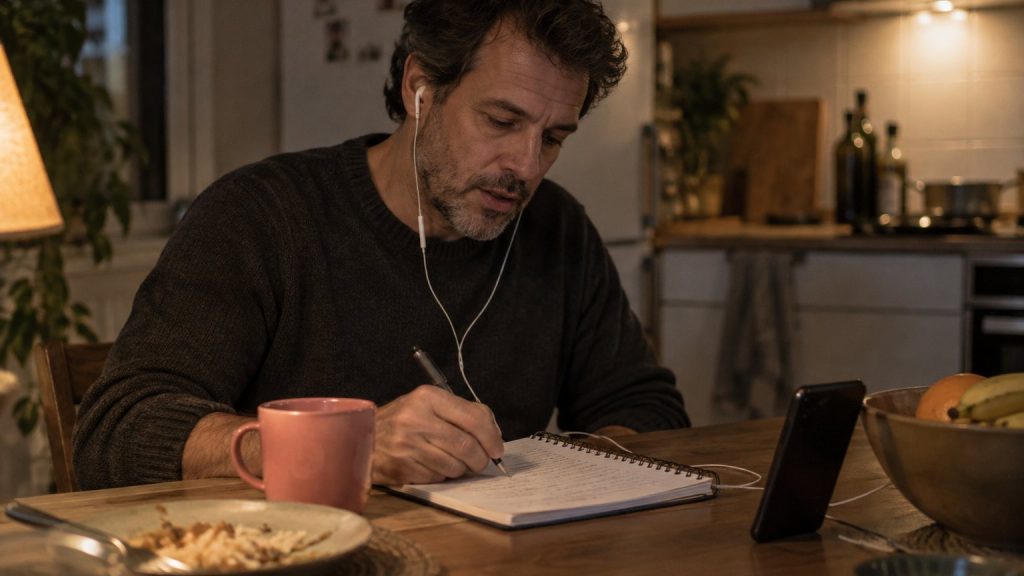
- Ask her which language her family speaks at home. Not which language she learned at school: which one her mother uses on the phone, and whether they mix in English.
- Learn the greetings and the polite words. In Tagalog that’s kumusta (how are you), salamat (thank you), and po and opo for her parents and grandparents; in another language, ask her for its greeting and its respect words. These go a long way in the first five minutes of any visit.
- Learn the phrases her family says every day. Ask her for ten, such as what her mother says when you arrive, at the table, when someone leaves. If they speak Tagalog, Kumain ka na? (have you eaten?) is a good one to ask about.
- Add the grammar you need to make your own sentences. Pronouns, question words, and how a verb shows whether an action is done, going on or still to come. Other grammar can wait.
- Listen every day. Ten minutes of real Tagalog speech, or her family’s language, lets you hear how words run together, which a word list can’t show you.
- Speak every day, with more than one person. Practise with her, and add a tutor or another speaker so your progress doesn’t rest on her alone.
None of the 18 teaching pages we read includes step 1, and it is the one that decides whether the rest of your work matches what you’ll hear at her family’s table.
Learn first the language her family speaks at home, and ask her which one that is rather than guessing.
Tagalog or Filipino: what do most Filipinos speak at home?
No single language is spoken in most Filipino homes: Tagalog is the largest, in about 4 in 10 households, and about 6 in 10 households speak another language. In the Philippine Statistics Authority’s 2020 census, Tagalog was the language spoken at home in 39.9% of Philippine households, Bisaya or Binisaya in 16.0%, Hiligaynon (Ilonggo) in 7.3%, Ilocano in 7.1% and Cebuano in 6.5% 1. That counts the language each household speaks, not how many people can speak Tagalog. The census lists Bisaya/Binisaya and Cebuano on separate rows. Bisaya usually means Cebuano (some speakers of other Visayan languages use the name too), and the same reference page’s chart adds the two rows together as Cebuano, about 22.5% of households; read that total as an estimate, since some households answering Bisaya may speak another Visayan language.
Filipino and Tagalog are close to the same thing for a learner. Filipino is the national language, built on Tagalog, and the Constitution makes Filipino and English the official languages, with the regional languages as auxiliary official languages in their regions 2. A course that teaches Filipino and one that teaches Tagalog give you nearly the same language. What changes from home to home is what people speak at the kitchen table.
Filipino and English are taught in schools across the country, and much of national television is in Tagalog or Filipino, so Tagalog is rarely wasted. It just may not be the language you hear when her mother calls.
Your turn
Which language will you hear at her family’s table?
Which language does her family speak at home?
We keep your answer anonymously, with the date, and nothing else.
If her family speaks Bisaya or Taglish
If her family speaks Bisaya, learn the greetings and the everyday phrases in Bisaya first, and keep Tagalog for the wider country. If they speak Taglish, the mix of Tagalog and English, learn Tagalog words in the places where they use them, and let the English parts stay English.
She speaks Bisaya with her mother: should I learn Tagalog or Bisaya?
Learn Bisaya if her family speaks it at home and you want to follow them; learn Tagalog if you want the language of national television, Manila and most courses. If following her family is your main goal, keep going in Bisaya past the first phrases, and add Tagalog separately if you also want it for travel and the wider country. Fewer courses teach Bisaya, so a tutor or her family will carry more of the teaching. Bisaya (also called Cebuano or Binisaya) is spoken across much of the Visayas and Mindanao, in cities like Cebu and Davao. Ask her which language they mean by Bisaya: Cebuano speakers use the name, and so do some speakers of Hiligaynon or Waray. If her family is from there, the phrases you’ll hear on calls are Bisaya ones: maayong buntag (good morning), salamat kaayo (thank you very much), nikaon na ka? (have you eaten?).
None of this holds if she and her family moved from a Bisaya-speaking area to Manila long ago, since they may use Tagalog at home now. Ask, don’t guess from her hometown.
Quick poll
If her family speaks Bisaya, which would you learn first?
Anonymous count, nothing else stored.
Her family mixes English and Tagalog in one sentence: can I learn Taglish on purpose?
Yes, you can learn Taglish on purpose: if her family mixes Tagalog and English, practise that mix. A sentence like “Nag-lunch ka na?” (have you had lunch?) takes an English word and gives it a Tagalog verb form. Of the 18 teaching pages we read, 5 say Filipinos mix English into Tagalog: 4 present it as ordinary speech you’ll meet and may use, and 1 warns beginners against using it too early. They disagree, so listen to how her family talks and let that settle it. If they mix, you can mix.
Switching languages inside a sentence has a name, code-switching, and it isn’t a sign of poor Tagalog. It is how many bilingual people talk.
Taglish isn’t broken Tagalog. In many homes it’s simply how people talk.
Tagalog, Taglish or Bisaya? Learn to tell them apart
Telling which language someone is using is the first skill you need on a family call, and you can start before you understand every word. Tagalog sounds like “kumain ka na?” and “salamat po”. Taglish drops English words into Tagalog grammar: “sige, call kita later”. Bisaya uses words you won’t find in a Tagalog course: kaayo (very), asa (where), dili (no, not). Bisaya speakers mix in English too, and whether an English word counts as borrowed or switched in matters less than the grammar around it: the grammar tells you which language you’re hearing. The challenge below is reading practice with made-up messages, and its Bisaya ones keep to Bisaya so the difference is clear. To train your ear, ask her to read the same lines aloud, or listen for these words on her family’s calls.
Challenge yourself
Tagalog, Taglish or Bisaya?
Seven made-up messages from a Filipina’s family, to read. For each one, decide which language it’s in: Tagalog, Taglish (Tagalog grammar with English words mixed in) or Bisaya. Bisaya speakers mix in English too; these Bisaya messages keep to Bisaya. Then see the words that give it away, and how you did against everyone else.
1. Grace’s mother
A video call. Her mother leans into the screen.
- Grace’s mother Kumain ka na, anak?
Answer: Tagalog
Kumain ka na? (have you eaten?) is Tagalog, and anak means child. No English word, no Bisaya word.
Worth knowing: In Bisaya the same question would be nikaon na ka?
2. Joy’s mother
Joy’s mother calls her while you’re both at the table.
- Joy’s mother Nikaon na ka, day?
Answer: Bisaya
Nikaon na ka? is have you eaten? in Bisaya. Day is a common Bisaya way to address a girl.
Worth knowing: If you hear nikaon instead of kumain, the family speaks Bisaya. Learn their phrases first.
3. Rhea’s cousin
Her cousin answers a message in the family chat.
- Rhea’s cousin Sige, call kita later, may meeting pa ako.
Answer: Taglish
Call and later are English, the rest is Tagalog: sige (OK), kita (you, from me), may meeting pa ako (I still have a meeting).
Worth knowing: This is everyday speech in many homes. You can learn it as it is.
4. Mae’s aunt
You brought gifts. Her aunt sends a voice message afterwards.
- Mae’s aunt Salamat kaayo sa pasalubong!
Answer: Bisaya
Kaayo (very) marks it as Bisaya: thank you very much for the gifts. Salamat is shared by both languages.
Worth knowing: In Tagalog it would be maraming salamat sa pasalubong.
5. Liza’s brother
Her brother arrives late for dinner.
- Liza’s brother Grabe, ang traffic kanina, na-late ako.
Answer: Taglish
Traffic and late are English, with a Tagalog verb form on late (na-late, got late). That’s Taglish.
Worth knowing: Don’t wait to understand every word: picking out the English ones gives you the topic.
6. Ana’s lola
As you leave, her grandmother walks you to the gate.
- Ana’s lola Mag-ingat kayo sa biyahe, ha.
Answer: Tagalog
Mag-ingat kayo (take care, to you both) and biyahe (trip) are Tagalog. Answer with opo, salamat po.
Worth knowing: Biyahe comes from Spanish, like many Tagalog words, but it’s still Tagalog.
7. Carla’s father
Her father messages as your plane lands.
- Carla’s father Asa na kamo? Naa na kami diri.
Answer: Bisaya
Asa (where), kamo (you, plural), naa (be there, be in) and kami (we, not including you) are Bisaya: where are you? We’re here already.
Worth knowing: No English word here. Asa and naa are good signs that you’re hearing Bisaya.
You can tell which language a family is speaking long before you understand it. Ask her which one hers uses, and learn that one first.
These families and messages are made up, built from everyday phrases. We keep your answers and score anonymously, with the date, and nothing else.
Why an app’s Tagalog can’t follow her family’s calls
An app or course usually gives you slower, more standard speech than her family uses, and their conversations may be in another language or a mix. Two of the 18 teaching pages we read say textbook or translated sentences differ from how people speak. Add the census figure, about 6 in 10 households speaking something other than Tagalog at home, and a gap between what you study and what you hear is to be expected. That’s our reasoning from the figures, not a count of learners.
Ask her to say her mother’s three most common questions herself, and learn those. If you’d like her mother’s own voice, ask her mother first, and keep the recording on your phone rather than uploading it to an app. Ask her what the family actually says for yes, no, wait, let’s go and are you hungry. The app is still useful for structure and vocabulary. It just can’t tell you which words her family uses.
I can read Tagalog but not understand it spoken: how do I train my ear?
Train your ear with short, repeated listening to real speech, not with more reading. Pick one clip of everyday talk, a minute or two, and play it several times a day for a week: first just listening, then with the words written down, then without them again. Ask her to say a sentence at normal speed, then slowly, then normal again. In fast speech, words run together and short ones get swallowed, which reading never shows you.
Is Tagalog hard to learn, and how long does it take?
Tagalog has parts that come quickly to an English speaker and parts that take longer. It uses the Latin alphabet, is mostly written as it sounds, and is full of Spanish and English words you’ll recognise (mesa, kotse, kompiyuter). Spelling has one catch. Everyday writing doesn’t mark stress, so puno means tree with the stress on the first syllable and full with it on the last, and you learn those by hearing them. The verbs take longer. They change with small additions at the start or in the middle of the word, and those changes show whether an action is done, going on or still to come, and who or what the sentence is about.
Is Filipino an easy language to learn? It depends on what you need to do with it. Greeting her family and asking a few rehearsed questions is the part you can do soonest; understanding replies you didn’t expect takes longer; following a fast family conversation takes longest. The teaching pages disagree: of the 18 we read, 3 say Tagalog is easy, 2 say it isn’t, and the 5 that give a time estimate run from about 6 months to 3 to 4 years. No honest page can give you a date, so check your progress by what you can do. After a week, can you greet her parents with their respect words (po, if they speak Tagalog) and ask one question? After a month, can you tell Tagalog from Taglish or Bisaya on a call? What you control is minutes a day and whether they go on the language her family speaks.
Quick poll
How much time a day could you give to learning?
Anonymous count, nothing else stored.
The verb forms confuse me: which grammar does a beginner actually need first?
A beginner needs pronouns, question words and one verb pattern in its three forms first. Learn these before anything else:
- Pronouns: ako (I), ikaw or ka (you), siya (he or she), tayo (we, including you), kami (we, not including you), kayo (you, plural or polite), sila (they).
- Question words: ano (what), sino (who), saan (where), kailan (when), bakit (why), paano (how), magkano (how much).
- One verb pattern: kain (eat) becomes kumain (done: ate), kumakain (going on: is eating) and kakain (not yet started: will eat). Tagalog verbs mark aspect, whether an action is done, going on or not yet begun, rather than English past, present and future tense; dictionaries call the three forms complete, progressive and contemplative. The same -um- pattern works for inom (drink): uminom, umiinom, iinom; alis (leave): umalis, umaalis, aalis; and bili (buy): bumili, bumibili, bibili. With ako (I): Kumain ako (I ate), Kumakain ako (I’m eating), Kakain ako (I’ll eat). Not every Tagalog verb works this way, but these four get you through a day of simple sentences.
Leave the rest of the verb system for later. You can hold a simple conversation long before you master it, and if a wrong form confuses someone, say it another way or ask her to help.
Po and opo: how to show respect to her parents and lola
If her family speaks Tagalog, add po to what you say to her parents, grandparents and other older relatives, and answer them with opo for yes. Po is a marker of politeness, and ho is a less respectful form of it 3. Salamat po is thank you to an elder; opo is yes; hindi po is no. Only 1 of the 18 teaching pages we read explains po and opo, though it’s the first thing her parents will hear from you.
When do I use po and opo, and will I sound silly if I get it wrong?
Use po with anyone older than you or her, anyone you’ve just met, and anyone in authority; drop it with her and with younger cousins. Getting it wrong in the polite direction sounds a little stiff or funny, and her younger relatives may laugh. If in doubt, use po with her older relatives, and ask her what sounds natural in her family.
Po is a Tagalog word, so if her family speaks Bisaya at home, ask her how they show respect to elders, because the words can differ.
Challenge yourself
Po or no po?
Six made-up moments with a Filipina’s family. For each one, decide whether your reply needs po, needs no po, or calls for a quick question to her first. Then see the reply that fits, and how you did against everyone else.
1. Grace’s lola
Sunday lunch at her family’s house. Her grandmother pushes the rice towards you.
- Kain pa, iho.
Answer: add po
She’s an elder, so thank her with po: Salamat po. If you’re full, Busog na po ako (I’m full) says it with respect.
Worth knowing: Opo is yes to an elder; oo is yes to everyone else.
2. Grace’s cousin
Her cousin, about 15, sits next to you and asks about the food.
- Masarap ba, kuya?
Answer: no po needed
He’s younger and just called you kuya (older brother). Oo, masarap! (yes, it’s delicious) is fine; po to a teenager sounds a little funny, not rude.
Worth knowing: Kuya and ate (older sister) are how younger people address you, as a sign of respect to you.
3. Grace
Back at your place. She calls from the kitchen.
- Gusto mo ng kape?
Answer: no po needed
With her, plain Tagalog is normal: Oo, salamat (yes, thanks). Po to your girlfriend would sound playful or oddly distant.
Worth knowing: In everyday talk, couples don’t use po with each other.
4. Grace’s father
Her father walks you to the gate as you leave.
- Uuwi ka na ba?
Answer: add po
He’s her father, so answer with opo: Opo, salamat po (yes, thank you). Plain oo would sound too casual to him.
Worth knowing: Uuwi ka na ba? means are you going home now?
5. The tricycle driver
A tricycle driver in his fifties asks where you’re headed.
- Saan tayo, sir?
Answer: add po
He’s older and a stranger, so po fits even though he calls you sir: Sa palengke po (to the market).
Worth knowing: Po to strangers older than you is ordinary politeness, not flattery.
6. Joy’s tita
Joy’s family is from Cebu. Her aunt greets you at the door, in Bisaya.
- Maayong buntag! Nikaon na ka?
Answer: ask her first
Po is a Tagalog word. When a family speaks Bisaya, ask her how they show respect to elders, because the words can differ.
Worth knowing: Maayong buntag is good morning in Bisaya, and nikaon na ka? is have you eaten?
With elders and strangers older than you, po is the safe default; with her and younger relatives, drop it; in a family that speaks Bisaya, ask her.
These families and moments are made up, built from everyday phrases. We keep your answers and score anonymously, with the date, and nothing else.
Her lola speaks only Tagalog: how do I hold a simple conversation with her?
Hold a short conversation with her lola by greeting her with respect, asking two or three simple questions with po, and letting the answers be long. Kumusta po kayo? (How are you?) Kumain na po kayo? (Have you eaten?) Ang sarap po (It’s delicious) at the table. Many families greet elders with the mano: you bow and touch your forehead to the back of the elder’s hand; ask your girlfriend whether hers does and show you’re ready to. You don’t need to understand every answer. Four phrases keep you in the conversation when you’re lost: Hindi ko po naintindihan (I didn’t understand), Pakiulit po (please say it again), Dahan-dahan lang po (slowly, please) and Ano po ang ibig sabihin niyan? (what does that mean?). Ask your girlfriend beforehand whether she’ll help translate when those run out.
Learn the whole respectful greeting her family uses, not just one word to add everywhere.
Common Filipino greetings and everyday words
The everyday Tagalog greeting is kumusta (how are you), and many Filipinos simply say “hi” or “hello” in English; ask her which one her family opens with. Here are the everyday words you’ll use first, with their polite form where it matters:
| You want to say | Tagalog | Polite, to an elder |
|---|---|---|
| Hi, how are you? | Kumusta? / Hi! | Kumusta po kayo? |
| Good morning / afternoon / evening | Magandang umaga / hapon / gabi | Magandang umaga po |
| Thank you | Salamat | Salamat po |
| You’re welcome | Walang anuman | Walang anuman po |
| Yes / No | Oo / Hindi | Opo / Hindi po |
| Sorry | Sorry / Pasensya na | Pasensya na po |
| Excuse me (to pass) | Makikiraan / Makikidaan | Makikiraan po |
| Excuse me (to interrupt or ask) | Excuse me | Mawalang-galang na po |
| I want to ask something | May itatanong ako | May itatanong po ako |
| Have you eaten? | Kumain ka na? | Kumain na po kayo? |
| Take care | Ingat | Ingat po |
How do Filipinos say sorry and excuse me?
Filipinos often just say sorry in English; the everyday Tagalog is pasensya na (also spelled pasensiya), which also covers “excuse the trouble”. Patawad also means I’m sorry, but it asks to be forgiven, so save it for something that needs forgiving. For excuse me, makikiraan po gets you past someone in a crowded room, and mawalang-galang na po politely interrupts an elder. In Tagalog, “what is sorry” depends on how sorry you are: pasensya na for bumping into someone, patawad for something you need forgiven.
Why do Filipinos say “let’s eat” and “tao po”?
Filipinos often say kain tayo (let’s eat) as a polite offer when they are eating and someone arrives, whether or not they expect you to sit down; if you’re unsure, ask her whether you should join. “Have you eaten?” works the same way, as a way of saying hello and showing care. Tao po (literally “a person”, with po for respect) is what you call out at someone’s gate or door to say you’re there. If you visit her family, you’ll hear both on the first day.
How do you count 1 to 10 in Tagalog?
One to ten in Tagalog is isa, dalawa, tatlo, apat, lima, anim, pito, walo, siyam, sampu. For prices and the time, many Filipinos use Spanish-based numbers instead (uno, dos, tres), or English, so learn to hear all three.
What is the difference between Pinoy and Pinay, and is Pinay a bad word?
Pinoy means a Filipino, usually a man or Filipinos in general, and Pinay means a Filipina; both are informal words Filipinos use about themselves. Pinay is not a bad word. Many Filipinas use Pinay about themselves. From a foreign man who has just met her, Filipina is the safer word until you hear her use Pinay herself.
What is insulting in Tagalog, and why is gago a bad word?
Gago is a bad word because it means fool or idiot, and said to someone’s face it is an insult; dictionaries mark it vulgar, and it is also said on its own as a swear word when something goes wrong (ay gago!). The strongest common curse is putang ina, often said as an exclamation the way English speakers swear at a stubbed toe. Learn to recognise both and don’t use either: from a foreigner, and around her family, they land harder than you mean them to.
Learning from her: what to do when she switches to English
When she switches to English as soon as you struggle, ask her, if she’s willing, for something else: “Can we do ten minutes in Tagalog after dinner, and you only switch if I ask?” She may switch to spare you the embarrassment, because it’s quicker, or because she’s tired after a long day; you can’t know which without asking. Of the 18 teaching pages we read, only 1 mentions people switching to English when a learner’s level is low, and none tells you to ask her to help or correct you.
Make the request small and specific. Ten minutes a day, one topic, her correcting only the mistake that changed the meaning. A rule she agreed to is easier for both of you to keep than an open “speak Tagalog to me”, which can leave her feeling like your teacher all evening.
If she doesn’t want to teach, don’t take that alone as a judgment on you: teaching may be more work than she wants after a long day. That’s the moment to add a tutor or another speaker.
Ten minutes she agreed to beats an hour she puts up with.
She laughs when I try to speak: is she mocking me or charmed?
Her laugh alone doesn’t tell you whether she’s charmed, surprised or mocking you, so ask her. Hearing her own language from you can be sweet and funny at once, especially a word with the stress in the wrong place, or one that sounds like something her grandmother says. Ask her whether it was wrong or just cute, and tell her if the laughing puts you off. Her answer tells you whether to fix it or keep it. If it still stings after you’ve said so, do more of your practice with a tutor or another speaker.
Should I hire a tutor or keep learning from my girlfriend?
Do both if you can: a tutor for structure and steady practice, her for the phrases her family uses and for the moments that matter. One of the 2 teaching pages written for a man learning for a partner is a tutoring business, and it warns against learning from your wife, which is also what it sells. Ask the tutor to keep the lesson in Tagalog, and the lessons take the teaching pressure off your evenings. She knows how her family really talks, which no tutor can teach you. If her family speaks Bisaya, look for a tutor who speaks it.
Quick poll
Would you want her to correct every mistake you make?
Anonymous count, nothing else stored.
Free ways to learn Filipino: apps, translators, films and songs
You can learn Filipino free with a language app’s free lessons, Filipino films and songs, and practice with her and her family. Free apps are good for vocabulary and the daily habit. Before you pick one, check three things: that it teaches Tagalog, or her family’s language; that it plays recordings of real speakers; and that the free part goes beyond the first few lessons. None of them teaches her family’s own phrases; she does.
Is a translator app enough to talk with her family?
A translator app is enough to read a message or get through a single sentence, not to hold a conversation. It may not handle Taglish or Bisaya well, and it tends to give you formal Tagalog her family may not use, so treat its answer as a fallback, not proof. Use it to check a word, then ask her whether that’s how they would say it.
Are Filipino films and songs useful practice for a beginner?
Filipino films, series and songs are useful practice once you know a few hundred words, mainly for training your ear. Watch with English subtitles first, then Filipino subtitles, then none. Songs teach rhythm and some vocabulary, but their words are often poetic, so don’t speak like a love song at the dinner table. Ask her what her family watches; that’s the Tagalog, or Bisaya, they’ll talk about.
What the pages that teach Tagalog tell you, and what they leave out
The pages that teach Tagalog cover method, greetings and hours well, and almost none of them is written for a man learning for a partner. We read 18 English pages from 15 sites that Google showed for “how to learn Tagalog” and similar phrases on 10 October 2026, and coded what each says, keeping the exact sentence behind every code. 12 of the 18 show a sales or affiliate link for lessons, an app or tutoring. 5 say Tagalog isn’t the only language Filipinos speak, and 5 say Filipinos mix English into Tagalog. 0 tell you to find out which language her family speaks. 0 tell you to ask her to help or correct you. 2 are written for someone learning for a partner or her family.
For you, it means the advice you’ll find is about method, and method is fine. The question no page asks, which language and which mix her family uses, is the one that decides what you study. Two of the pages give a first-language share for Tagalog (about a quarter, about a third) that differs from the census household figure; the census figure is the one used here. What this count doesn’t show is what actually works for learners: we found no learner’s or Filipina’s account that passes our rules for sources.
Your turn
What do the pages that teach Tagalog tell you?
Of 18 pages that teach Tagalog, which do you think most of them do?
18 English pages Google showed for how to learn Tagalog, October 2026 (our count)
- Sell lessons, an app or tutoring 12 of 18
- Say how long it takes 5 of 18
- Say there are other languages 5 of 18
- Say Filipinos mix in English 5 of 18
- Write for a man with a partner 2 of 18
- Say to ask her family’s language 0 of 18
- Say to ask her to correct you 0 of 18
We keep your answer anonymously, with the date, and nothing else.
Practising on video calls when you live apart
On video calls, practise one topic for ten minutes rather than trying to hold an open conversation in Tagalog. A call loses the gestures and the shared room that help a beginner guess, so fast speech is harder to follow than at a table. That’s our reasoning from how calls work; we found no learner’s account of it. Plan the topic before the call: today’s food, the weather where she is, what her family did on the weekend. When her family joins, greet them in their language, ask one question with their respect words (po, if they speak Tagalog), and let her translate the rest if she’s happy to.
Before your next visit to her family: goals you can check
Set goals you can check before the visit rather than a date for fluency. Can you greet each of her parents with their respect words (po and opo, if they speak Tagalog)? Can you ask and answer three simple questions, about food, the trip and her family? Can you tell from a call which language they’re speaking? Can you say you didn’t understand and ask them to repeat? How long these take depends on your minutes a day and on the language, and nobody can promise a date. You won’t follow every conversation, and that’s fine. What counts at the table is that you learned their words, not textbook ones. Build your plan below; the page writes it out for you.
Build your plan
Your first months of Tagalog, or her family’s language
Tap what fits you. The page writes a short practice plan you can copy. Nothing you tap leaves your device.
Which language does her family speak at home?
- Tagalog
- Bisaya
- Tagalog and English mixed
- Another language
- Not sure yet
How much time can you give each day?
- About 10 minutes
- 20 to 30 minutes
- An hour or more
What do you want first?
- Follow her family’s calls
- Greet her parents and lola
- Talk at the table on a visit
- Talk with her in her language
Who can you practise with?
- Her
- A tutor
- Her and a tutor
- Nobody yet
A plan, not a promise: nobody can say how fast you’ll learn, and which language her family speaks is something only she can tell you.
Everything stays on your device. We don’t keep or send what you tap.
Should I learn Tagalog so our children grow up bilingual?
If you may raise children together, learning her language lets you follow what her family says to them, and which languages the children grow up with is a decision for the two of you. Your learning doesn’t have to make you their teacher. It keeps you from being left out at the table when everyone around you, children included, speaks it. If her family speaks Bisaya, that’s the language the children will hear from their grandparents.
Start with one question to her
Start tonight by asking her which language her family speaks at home, and which ten phrases she’d teach you first. Then give it ten minutes a day, with respect words for her elders (po, if they speak Tagalog) and a second speaker for when she’s tired. For what to say once the two of you are close, see our guide to romantic Tagalog phrases; for the names she might like to be called, see Filipino pet names for your girlfriend. More on the relationship itself is in our tips for dating a Filipina.
A few phrases her family uses every day will do more for you than a course that promises fluency by a date.
How we put this page together: On 10 October 2026 we pulled the top Google results (US, English, depth 20) for 8 ways a man asks how to learn Tagalog or Filipino, some naming a girlfriend or her family: 142 result rows (the same page often ranks for several searches) at 98 distinct addresses. We set aside the 61 rows that were videos, social posts, forum threads, question-site answers and app-store pages. Of the other 47 distinct addresses, we did not fetch 17 (course home pages, tools and sample lessons, chosen by title), stopped at 3 whose sites refused or disallowed us after we checked robots.txt, and read 27, setting aside 9 of those (course sales pages, word lists, a lesson list, a course listing, an app page with no text). Each address is counted once, at the step that removed it. We coded the other 18 pages, from 15 sites, against a codebook fixed before coding, keeping and checking the exact sentence behind every code. Found: 12 show a sales or affiliate link; 5 say Tagalog is not the only language Filipinos speak; 5 say Filipinos mix English into Tagalog (4 as ordinary speech, 1 warning beginners off it); 5 give a time estimate, from about 6 months to 3 to 4 years; 3 call Tagalog easy and 2 say it is not; 2 are written for someone learning for a partner or her family, and 1 of those, a tutoring business, warns against learning from your wife; 1 explains po and opo; 1 says people switch to English when a learner’s level is low; none tells the learner to find out which language her family speaks, and none tells him to ask her to help or correct him. We also looked on a question-and-answer forum for learners of Tagalog writing about a partner and found none. The household language shares come from the Philippine Statistics Authority’s 2020 census as tabled on Wikipedia (the PSA release itself sits behind a browser check we did not get past), and the official languages from the 1987 Constitution.
Why we made it: A man learning Tagalog for a Filipina finds pages that teach one standard language and a method, most of them selling lessons, while about 6 in 10 Philippine households speak something other than Tagalog at home. We made this page so he starts from the language her family actually speaks, learns the words her parents and lola will hear first, and has a way to practise with her that both of them can keep.
References
- 1
- 2
- 3
How this article was made
Researched and drafted with AI assistance from the sources cited below, then reviewed, edited and fact-checked by a human editor before publishing. Every factual claim is tracked in our verification ledger.
Read our full editorial policy →
Comments
Every comment is read by a person before it appears, usually within 48 hours. First names or pseudonyms only.
More comments load as you scroll.