
The cost of living in Thailand for an average Thai household is about 22,400 baht a month, roughly $680, about 32,700 baht in Bangkok and 34,200 in Phuket. That is a Thai family's month, and Thais have state health cover. A foreign partner's month can add private health insurance, imported food, flights home and money for her parents.
 CultureCan a Christian Marry a Buddhist? Dating and Marriage25 min read
 CultureHow Hard Is It to Learn Thai, and How Long Does It Take?21 min read
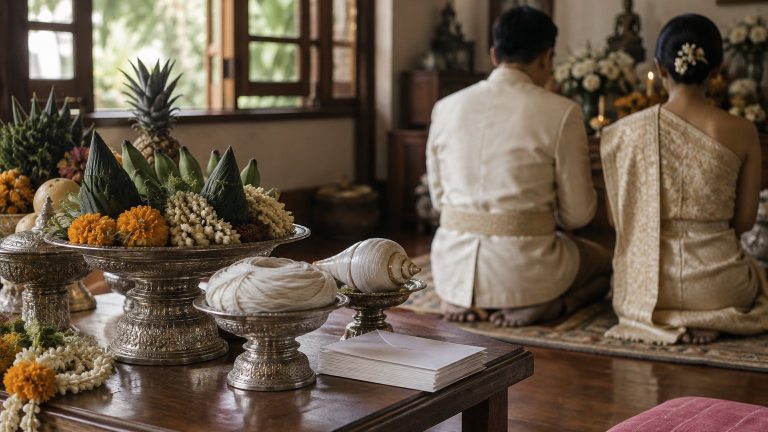 CultureThai Wedding Traditions and Ceremony: What to Expect27 min read
 Relationship SkillsRelationship Skills for Couples, With a Thai Woman24 min read
 ThailandHow to Attract an Asian Woman: What Women Notice in a Man26 min read
Contents · 7 sections
Thailand’s national household survey counts what tens of thousands of real households spend, province by province, and it is the starting point here. The guides we checked price one foreigner living alone from crowd-sourced price lists.
This page is for a man planning a life there with a Thai partner. It starts from what Thai households actually spend, shows which of your costs that average can’t tell you, and adds something the expat guides we checked don’t: what Thai women with foreign partners write, in Thai, about who pays at home and whose money goes to their parents. If you’re still weighing the move itself, living in Thailand covers the bigger decision.
How much does it cost to live in Thailand per month?
A Thai household spent 22,420 baht a month on average in 2025, not counting saving or buying a home, and it held about two and a half people. Food, drink and tobacco took the biggest share, 8,420 baht, then housing and household goods at 4,753 and vehicles and travel at 3,430 1. The same survey breaks spending down by province:

| Province | Household spend a month | In US dollars | People per household |
|---|---|---|---|
| Phuket | 34,215 baht | about $1,040 | 2.4 |
| Bangkok | 32,695 baht | about $990 | 2.2 |
| Chonburi, which includes Pattaya | 25,423 baht | about $770 | 2.1 |
| Whole country | 22,420 baht | about $680 | 2.5 |
| Prachuap Khiri Khan, which includes Hua Hin | 20,464 baht | about $620 | 2.7 |
| Chiang Mai | 19,508 baht | about $590 | 2.3 |
| Udon Thani | 18,297 baht | about $560 | 2.3 |
Baht figures are from the National Statistical Office’s 2025 household survey 1; dollars at the 2025 average rate of 32.9 baht to the dollar 2. Outside Bangkok these are averages for the whole province, villages included, so a home in Chiang Mai city, Pattaya or Hua Hin may run higher.
Read the table as context, not as a minimum and not as your budget. It is the survey’s measure of what a household spends to live, not a count of the cash a renting couple pays out each month. An average across all households mixes renters with families who own their home or live with relatives, so it barely tells a renting couple what rent will cost.
The useful way to use it: build your own month line by line, rent, utilities, food, transport, health cover, money for family, a reserve for emergencies and repairs, and yearly costs such as flights, visa and paperwork fees divided by twelve. Add any tax on your income; whether you owe it in Thailand, at home or both is a question for a licensed tax adviser. Then compare the total with the line for your province.
Quick poll
Where do your Thailand cost numbers come from?
Anonymous count, nothing else stored.
Cost of living in Thailand vs the USA: why the Thai average isn’t your budget
The low average is real, and it describes what Thai households buy. On the World Bank’s measure of what money buys locally, 10.6 baht bought in Thailand in 2025 what a dollar bought in the United States, while a dollar exchanged for about 32.9 baht 3.
The comparison is in “international dollars”, set equal to a US dollar at US prices, and it averages everything households in each country consume. Divide 10.6 by 32.9 and Thailand’s overall price level for household spending comes out at about a third of the US level. That is an average across the whole economy; it doesn’t mean a particular basket, yours or a Thai family’s, costs a third of its US price.
One line in that spending shows the gap. Thai households spent 276 baht a month on medicine and medical care in 2025, about $8 1. That line is medicine and care paid for directly; the survey counts insurance premiums in a separate group, outside everyday spending, so it isn’t everything a Thai household pays for health.
Part of the reason it is so low is cover. Thai nationals have state health schemes, and the universal one, known as the “gold card”, is open to Thais with a Thai ID number who have no other state cover such as social security 4. A foreign partner doesn’t qualify for it. Unless you have cover through a job, from your home country or from a policy you already hold, the line that costs a Thai family the price of two noodle lunches costs you an insurance premium.
Price these separately, because the Thai average can’t tell you what they’ll cost you:
- Usually cheap, because you buy what Thais buy: rent in an ordinary Thai apartment block or house, local food at markets and food courts, buses, songthaews and motorbike taxis, phone and internet.
- Price them yourself: private health insurance, anything imported (cheese, wine, Western breakfast food, branded goods), a car, flights home to see your family, and international schools if you have children.
“A third of US prices” is an average across what Thai households buy, not a price for your basket. The more of your month goes on insurance, imports and flights, the less that number describes you.
When this doesn’t hold: if you bring health cover from an employer or your home country, own or live rent-free, eat local and rarely fly, you’ll have fewer lines to add to the Thai picture. The further your month leans on insurance, imports and travel, the less the average helps.
Monthly budget for a couple in Thailand
For a couple, build the month from your own lines, then agree who pays which. Only two of the Thai women we read gave a monthly budget for two in Thailand, and both were plans written in 2013, so read them for what they include, not for today’s prices.
We read the posts of 50 Thai women with a foreign husband or boyfriend on Pantip, a large Thai web forum, who wrote about money at home. Only 11 of the 50 lived in Thailand or were planning to move there; most lived abroad or didn’t say. Two gave a monthly budget for living in Thailand together, both still plans, in the same 2013 thread.
One, whose Scottish partner was due to retire, reckoned 30,000 baht would do for two in her rural district: no rent, no debts, rice from her sister’s farm 5. Another, planning to return with her husband, budgeted 70,000 baht a month, and her list began with first-class private health insurance for two. She also knew a couple in a province who spend about 60,000 a month with no luxuries; that husband eats simply but wants a European breakfast, and she noted the cheese and bread for it are expensive 5.
Between them they show the range of assumptions: rent-free in a province at one end, private insurance for two at the other. The 30,000 works because there is no rent; label it rent-free and 2013 prices, and don’t copy it if you’ll be renting.
Moving to her family’s district can take the rent out of your month. It does nothing to the cost of health cover, a car or the flights home.
How the bills get split varies. Of the 24 women in our count who said how their household is paid, 16 said the man pays all or most of it, 7 said they split, share or pool, and one keeps fully separate money. Of those 24, 13 live abroad, 6 didn’t say where and only 4 live in Thailand, so read this as how these couples arrange money wherever they live, not as a rate for couples in Thailand. One arrangement came up more than once among women who earn: he covers the home, and she keeps her own pay for her own costs and her family.
A monthly transfer seen from abroad is one number; what it pays for is another. If you’re sending money while you still live apart, label the payment, not just the person receiving it: the car loan you agreed to, the rent, her own spending. One woman in our count gets 15,000 baht a month from her husband, who works abroad, and 10,400 of it goes on the loan for a car he asked her to buy 6.
Quick poll
Who should cover the household bills?
Anonymous count, nothing else stored.
Is $2,000 a month enough to live in Thailand? And $500?
Whether $2,000 a month covers a couple depends on your rent, your age, your insurance and anyone else you support, and we haven’t priced rent or insurance for you. At the 2025 average rate it was about 65,800 baht, double what an average Bangkok household spends; the 70,000 baht one Thai wife budgeted for two with private insurance is a 2013 plan, not a current price. Treat these figures as illustrations: $2,000 covers you only if your own quotes for rent and insurance fit inside it with room for every other line.
$500 a month is about 16,400 baht. That is below what an average Thai household spends in any of the six provinces we list, Udon Thani’s 18,297 baht included. It is a very tight budget for one person and not a realistic one for a couple; check it against real rent, utilities, food and transport before you trust it. A foreigner without health cover on that budget has nothing to meet a hospital bill.
Quick poll
What monthly budget would you aim for as a couple?
Anonymous count, nothing else stored.
How much US money you need to live comfortably depends on the exchange rate as much as on prices, and the rate moves. The baht averaged 35.3 to the dollar in 2024 and 32.9 in 2025 2. The same $2,000 bought about 70,600 baht a month in 2024 and about 65,800 in 2025: roughly 4,800 baht less a month for the same life, before a single Thai price changed.
If your income is in dollars, pounds or euros, your Thai cost of living moves with the exchange rate. Plan your month in baht and check it at a weaker rate than today’s, with fewer baht to your dollar.
How long will $100,000 last in Thailand? At the 2025 rate it is about 3.3 million baht: roughly four years at 70,000 a month, or about nine years at the rent-free 30,000 (both 2013 plans), before any returns, inflation, exchange-rate moves or a large bill. That is simple division, not a retirement plan. Take your savings, pension and timing questions to a licensed financial adviser before you move.
Moving also has one-off costs that a monthly figure leaves out: a deposit and rent in advance on a home, furniture, a car or motorbike, and the flights to get there.
Health insurance in Thailand for a foreign partner
Health cover was the cost the women we read named most often, though only 6 of the 50 named it, and a monthly cost-of-living table often has no line for it. Your Thai partner will normally be covered by a state scheme, the gold card if she has no social security or other state cover; the gold card isn’t open to you 4.
In our count of 50 women, 5 named health insurance as a cost or a reason to hesitate, and three of them were planning a move to Thailand with a foreign husband. One wrote that without cover a foreigner pays every hospital bill himself, that premiums climb with age and that an insurer may decline to renew after a serious illness. She said this was one reason she and her husband were thinking hard about moving back at all 7.
Another, looking for cover for her husband, found insurers that stop at age 70 or cap the cover at one or two million baht 8. A third said they keep savings for her husband’s future operations, which she prices in the millions of baht, because, she wrote, health insurance in Thailand won’t accept him 9.
These are what these women found, not a description of today’s policies. So your budget needs a health line, at the age you’ll be in ten years, not the age you are now. Before you treat a premium as that line, check the age a policy stops renewing, how premiums rise, what it excludes and how much it pays in total. If you can’t get cover, a savings reserve is a much bigger and less certain number, and it may change whether the move makes sense. For choosing a policy, a licensed insurance broker in Thailand is the person to ask.
A cost-of-living table with no health insurance line is built for someone with state cover, such as a Thai citizen. Unless you have cover of your own, add the line.
Quick poll
How will you cover health costs in Thailand?
Anonymous count, nothing else stored.
Money to her parents: is it part of your budget?
Of the 50 women we read, 29 said whether money goes to their parents, and 24 of them send some. It’s yours only if the two of you agree it is: of the 23 senders who said whose money it is, 14 send their own.
Don’t assume her parents have a pension. Among Thais aged 60 and over, the most common main source of income is their children (35.7%, and 41.7% of older women), ahead of work, and only 6.8% live mainly on a pension 10.
The state old-age allowance is 600 baht a month in your 60s, rising to 1,000 baht at 90 11. Three women in our count whose husbands are Western said his parents take no regular money from their children because they have their own, from pensions or savings 12 12. Hers may have neither.
Of the 29 women who said whether money goes to their parents, 24 send some. Of the 23 who send and said whose money it is, 14 send their own earnings or savings, 6 send his money (two of them from a monthly allowance he gives her), 2 send money from a shared purse and one sends some of each. Two women recommended the same split in their own words: his money, her money and the couple’s money; one of them pays her father from hers 13 13.
The money to her parents is often her own. Count the expense, then establish who pays it.
Whose account it comes from and what it does to your shared month are different questions. If she pays her parents from her pay because you cover the home, the money still shapes what the two of you can save. Agree the household total, the family amount and the savings goal together, without treating either partner’s income as automatically the other’s.
Where it goes wrong is when nobody agreed. If she has stopped working abroad and has no savings of her own, the request lands on him; three women in our count described money for their family causing friction with their partner, and two of them, not earning, had to ask him for it 14. One woman who had just moved abroad took a job within three months of arriving, against his family’s advice to learn the language first, so she could meet the requests herself 15. If she can’t work yet, agree a fixed figure from his money before the first request arrives.
The calmest account settled it early. A woman married seven years gets a monthly allowance from her husband that rises with his pay; she saves from it for her parents and tells him every transfer, and he approves. They had talked it through before they committed 14.
Her family’s expectations are the part you’ll mostly hear about second-hand. Of the 20 women who mentioned what their family expects, 17 said relatives or neighbours expect more of them, and put it down to her partner being a foreigner: a bigger house, a car, a monthly sum, a large bride price. We found these posts by searching for money with a foreign partner, so they aren’t a fair sample of couples in general. The comparison often lands on her: one woman’s aunt held up a colleague whose foreign partner bought her parents a house and paid them every month 13.
Put the two worries side by side. Yours may be that you’ll become the family’s wallet. Hers, in these threads, is often that everyone at home now assumes she’s rich, and that what she sends won’t be enough. The practical rule serves both: one agreed figure, whose pot it comes from, and the same answer from both of you when relatives ask.
If a request ever comes for money before you’ve met in person, it’s a different question entirely, and how to tell if a woman online is scamming you covers it. For requests inside a real relationship, when your Thai girlfriend asks for money goes through the signs worth noticing, and meeting her parents helps with the family itself.
Your turn
If money goes, or will go, to her parents, whose money is it?
Where are you two now?
- Planning to live together
- Living together
- Married
23 Thai women with a foreign partner who send money to their parents, in our count
- Her own money 14 of 23
- Mine 6 of 23
- Our shared money 2 of 23
- Some of each 1 of 23
We keep your answer anonymously, with the date, and nothing else.
Cost of living in Thailand by city: Bangkok, Chiang Mai, Phuket or her home province?
Households in Phuket and Bangkok spend the most in our table, and those in Chiang Mai and Udon Thani the least; the gap is 13,000 to 16,000 baht a month. Spending isn’t the same as prices: it also reflects income, household size and what people choose to buy, so the table ranks what households spend, not what the same life costs in each place. For a couple, price your own rent and transport in the place you’re choosing, and don’t assume your insurance, flights and imported groceries follow the local average.
Quick poll
Where would you most likely live?
Anonymous count, nothing else stored.
- Bangkok: second in our table for household spending (32,695 baht); trains and buses mean many people live there without a car.
- Phuket and the beach towns: the highest in our table (34,215 baht in Phuket), on an island where tourism sets many prices; outside the town centres you’ll likely need your own transport.
- Chiang Mai: under 20,000 baht for the average household, the lowest of the tourist provinces in our table.
- Her home province: if it’s in the northeast, household spending there is among the lowest in our table (Udon Thani, 18,297 baht). Rent may disappear if her family has a home for you, but check what hospitals are within reach, whether you’ll need a car, and what living near her family means for money to her parents.
Every one of these figures is from the National Statistical Office’s 2025 household survey 1.
Your turn
Which line of your Thailand budget haven’t you priced yet?
We keep your answer anonymously, with the date, and nothing else.
How we put this page together: We read the posts of 50 Thai women with a foreign husband or boyfriend on Pantip, a large Thai web forum, found through 54 Thai searches about money with a foreign partner and checked against the saved pages on 6 October 2026: of 23 who send money to their parents and say whose it is, 14 send their own. We set this beside the 2025 national household survey by province, the 2024 survey of older Thais and the World Bank’s price and exchange-rate figures, each read at the source on the same day. We did not price rents or insurance ourselves.
Why we made it: The cost-of-living guides we checked price one foreigner living alone from crowd-sourced price lists, and none says why the Thai average is low or what changes when your partner is Thai. We made this page to show what Thai households actually spend, province by province, and which of a foreign partner’s costs that average can’t tell him; we read Thai women’s own posts because money for her parents is a line men worry about and the English guides don’t ask her side.
References
- 1
- 2
- 3
- 4
- 5
- 6
- 7
- 8
- 9
- 10
- 11
- 12
- 13
- 14
- 15
How this article was made
Researched and drafted with AI assistance from the sources cited below, then reviewed, edited and fact-checked by a human editor before publishing. Every factual claim is tracked in our verification ledger.
Read our full editorial policy →
Comments
Every comment is read by a person before it appears, usually within 48 hours. First names or pseudonyms only.
More comments load as you scroll.