
The relationship skills couples need are the same with a Thai partner. What changes is how they land, and whether either of you says so when one lands badly. How to check, and what 17 people in cross-cultural couples say.
 Relationship SkillsCan a Man Make a Woman Happy Without Money? Thai Women Say24 min read
 Relationship SkillsRed Flags in a Girlfriend: When a Relationship Turns Abusive35 min read
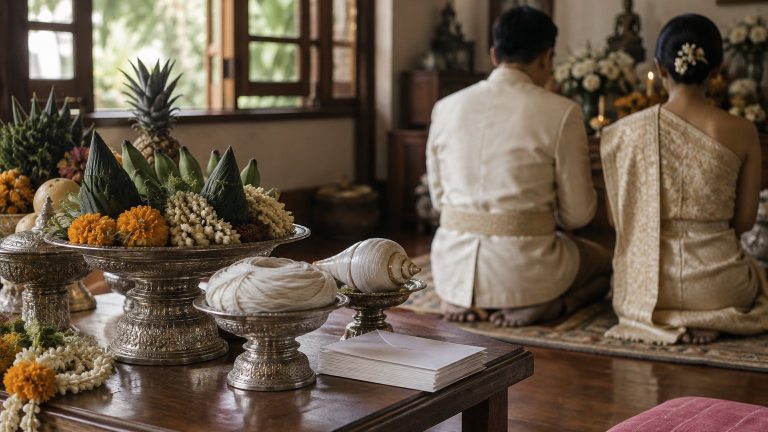 CultureThai Wedding Traditions and Ceremony: What to Expect27 min read
 ThailandHow to Attract an Asian Woman: What Women Notice in a Man26 min read
 Dating Thai WomenPassport Bro in Thailand: What to Expect27 min read
Contents · 12 sections
The relationship skills couples need are the same with a Thai woman as with anyone: knowing your triggers, understanding her side, staying calm, saying what you mean and making up after a fight. What changes is when and how each one lands, and whether either of you says so when one lands badly.
If telling you that something hurt would feel like embarrassing you or spoiling a good evening, she may let it pass, and you may do the same with her. The extra skill, then, is checking how something landed instead of waiting to be told.
We saved 100 threads from two public forums, the English-language Ask MetaFilter and the Thai-language Pantip, screened every post with a script and read each likely post in full. We found 17 people writing about their own partner from another culture, country or language, or with a different way of talking. Nine of them describe something left unsaid or heard differently from how it was meant, and nine describe a way of checking what was meant. Below, each skill comes with what it looks like in practice, what it can look like when it is missing, and one way to check that it worked.
What relationship skills do couples need?
Five skills come up again and again in advice for couples. This is our way of grouping that advice, not a tested or complete list, but it is a useful place to start practising with her:

- Self-awareness: knowing what sets you off, and what you do when it happens.
- Empathy: working out how things look from her side, including what she has not said.
- Emotional regulation: staying calm enough under stress to choose what you say.
- Communication: saying what you mean plainly, then checking how it was heard.
- Repair: owning your part after a fight, apologising for something specific, and coming back to the topic once you are both calm.
The first three are core parts of what is usually called emotional intelligence, the umbrella term for the emotional relationship skills couples need. Advice on the last two usually says to ask directly and listen fully. That still leaves a question. Will your partner tell you when your approach has upset her? In a couple from two cultures, and often two first languages, that can be the weak point.
The relationship skills that matter are the same with a Thai partner. What changes is when and how they land, and whether anyone says so when one lands badly.
Why a skill that worked before can land differently with a Thai partner
A skill that worked in your earlier relationships can land differently with her because the reaction that used to correct you may not come. If an earlier partner told you when your approach upset her, you had feedback you could use to adjust. A new partner may handle disagreement differently, because of culture, personality, language, her own history or simply how new the relationship is. If saying so feels costly to her, you may hear nothing, take the quiet as agreement and repeat the same approach.
So do not assume that silence or directness means the same thing to both of you; agree how either of you can flag a misunderstanding.
Research gives a reason for that caution, not a prediction about your partner. In a US laboratory study of students, holding back a feeling during a conversation made people less responsive and left their partner with a worse impression, but the cost was smaller for people with more Asian values 1. In a study of students in Japan, China, South Korea, Taiwan and the US, the Americans handled conflict in a more dominating way than the Japanese and Korean students, the Chinese and Taiwanese students handled it in a more obliging and avoiding way than the Americans, and concern for the other person’s face went with avoiding but also with working things out together and compromising 2.
A third study found Japanese students more reluctant than European Americans to ask for support when stressed, partly because they did not want to burden others 3. None of these studies included Thailand and none studied couples. They show that the habit of holding back differs between groups on average, not what your partner will d